White Paper
Environmental Risk Management Through Circular Economies In The Telecoms Sector
The environmental and financial case for upcycling set-top box fleets
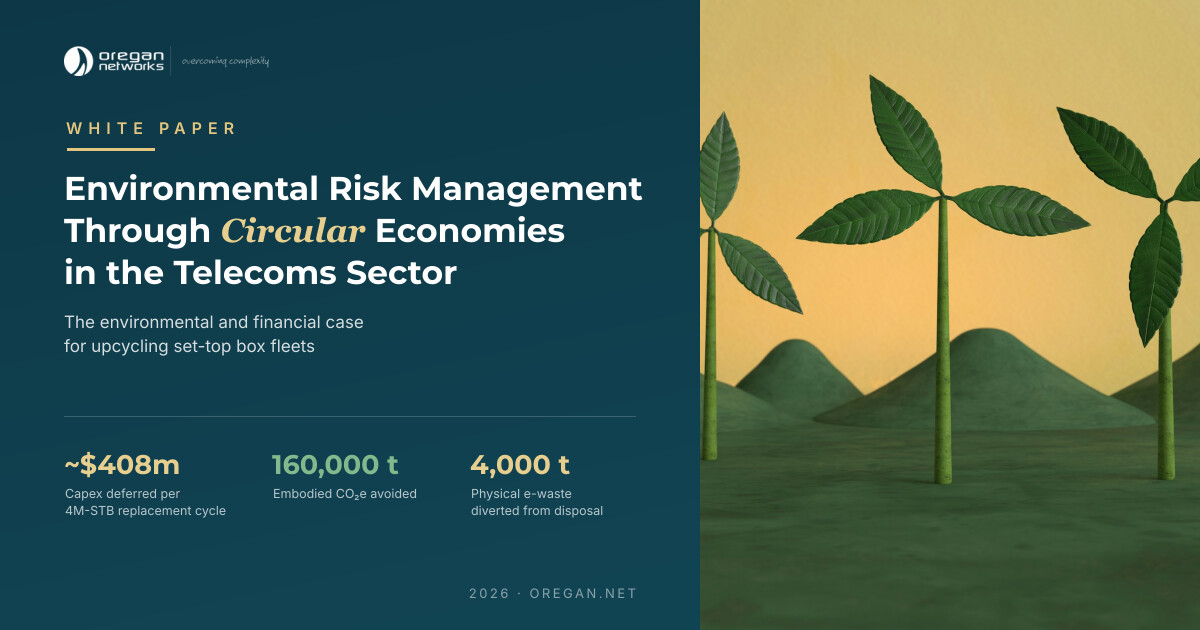
Pay TV operators face mounting financial and environmental cost from the continual replacement cycle of set-top boxes. The embodied carbon of manufacturing, shipping and deploying new hardware every 4–5 years drives significant capital expense, carbon emissions and electronic waste.
This white paper makes the environmental and financial case for upcycling — extending deployed STB fleets by 5+ years through in-field software upgrade to modernised backends, IP-first delivery and OTT super-aggregation, with no hardware swap. It quantifies the gains for a typical 4-million-STB operator, sets out which devices qualify, and shows how the engineering constraints are solved — backed by two live operator projects.
What's Inside
- Why STB replacement cycles are both a financial and an environmental liability
- The embodied-carbon case: ~0.16 Mt CO₂e and 4,000 tonnes of e-waste avoided across a 4-million-STB fleet
- The economics: ~$408m capex deferral and ~$400m in avoided truck-rolls, plus carbon valuation
- Which deployed STBs qualify — CPU, RAM, HEVC / AV1 and the 2017-onward Broadcom/Amlogic baseline
- Engineering modern OTT UX on constrained hardware — tackling latency, memory and software-DRM overhead
- Two live operator upcycling projects, including a cross-platform migration delivered in under 10 months