Quantifying The Financial And Environmental Return On Extending STB Fleet Life
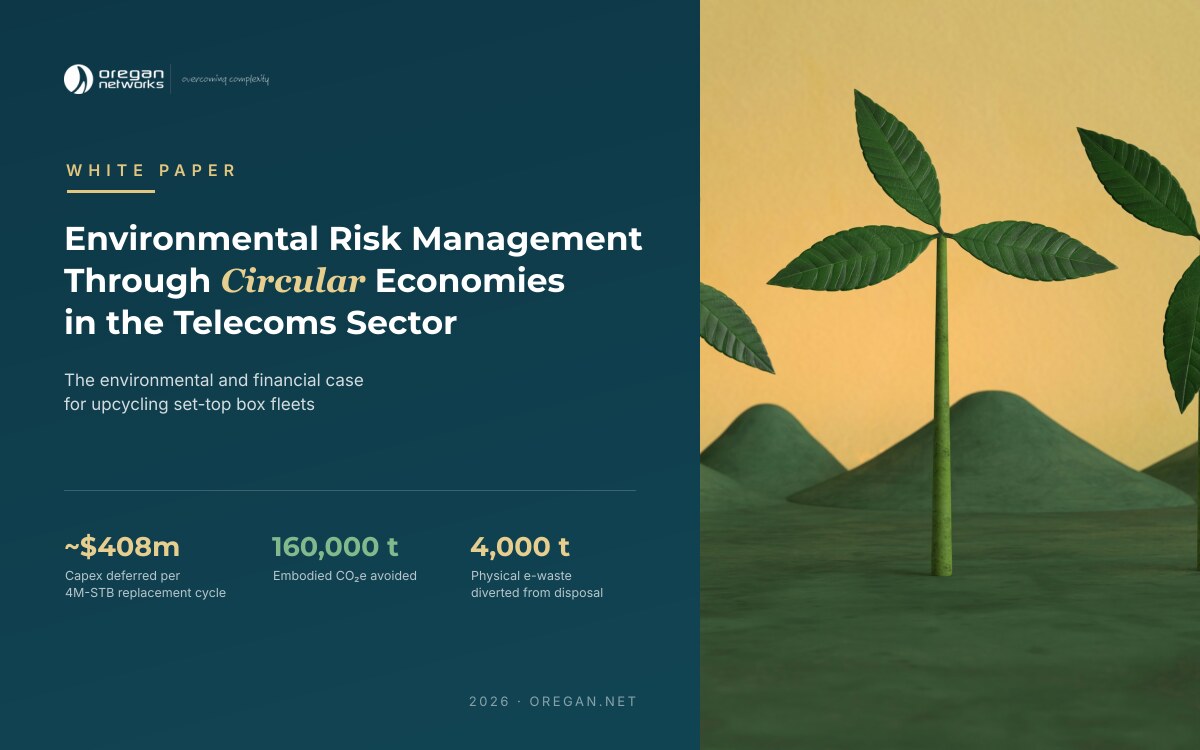
London, UK – 2 July 2026 – Oregan Networks, a British digital video software and systems consultancy, today published Environmental Risk Management Through Circular Economies In The Telecoms Sector, a white paper making the financial and environmental case for upcycling deployed set-top box fleets rather than replacing them.
The paper arrives as memory costs reshape the economics of customer premises equipment. Analyst firm Counterpoint Research reported in February 2026 that prices for the “consumer memory” used in broadband products — the class that includes routers, gateways and set-top boxes — had risen almost sevenfold in nine months, more than double the increase seen in smartphone memory, and that memory had grown from around 3% to more than 20% of the bill of materials in a low-to-mid-range router. In a June 2026 petition to the US Federal Communications Commission, cable trade body NCTA stated that DDR4 costs had “surged 700-800% year-over-year” and warned its members’ suppliers faced “significant supply shortages this year.”
For operators with fleets already in the field, availability is as pressing as price. The memory generations embedded devices depend on are being withdrawn rather than merely repriced: the largest suppliers exited DDR3 production to free capacity for AI-driven high-bandwidth memory, and NCTA told the FCC that manufacturers are discontinuing low-density eMMC modules below 64GB, including the 4GB and 8GB parts historically used in residential CPE. TrendForce reported in June 2026 that some DDR4 designs are being redesigned down to DDR3, and DDR3 designs down to DDR2. Meaningful new capacity is not expected before late 2027.
Against that backdrop, the white paper models the alternative for a typical four-million-STB operator. Extending fleet life by five or more years through in-field software upgrade — modernised backends, IP-first delivery and OTT super-aggregation, with no hardware swap — defers approximately $408m in capital expenditure and a further $400m in avoided truck-rolls, while avoiding around 160,000 tonnes of CO₂e and diverting 4,000 tonnes of e-waste.
The findings arrive as sustainability reporting turns hardware lifecycles into a disclosure question. Europe’s largest operators already report under the EU’s Corporate Sustainability Reporting Directive, whose standards cover resource use and the circular economy (ESRS E5), while the EU’s Ecodesign for Sustainable Products Regulation is introducing requirements for product durability, upgradability and repairability. A deployed set-top box fleet is increasingly an environmental impact that operators are expected to disclose and manage — not just a capital line.
The paper also sets out the engineering position: which deployed devices qualify, based on CPU, memory and HEVC / AV1 support across the 2017-onward Broadcom and Amlogic baseline, and how modern OTT user experiences are delivered on constrained hardware where latency, memory headroom and software-DRM overhead are the binding constraints. Two live operator upcycling projects are referenced, including a cross-platform migration completed in under ten months.
Milya Timergaleyeva, CMO of Oregan Networks, commented, “Replacing a fleet was always a capital decision. This year it is also a procurement risk — the parts are more expensive, the low-density memory these devices use is being discontinued, and nobody is promising relief before 2028. The deployed estate is an asset that already has years of service left in it, and the constraint is usually software, not silicon. We wrote this paper to put defensible numbers behind that argument.”
The nine-page white paper is available to download at oregan.net/white-paper/stb-upcycling/.
About Oregan Networks
Oregan Networks is an agile engineering specialist serving its international customer base of Pay TV operators from development and support centres in the UK, Scandinavia, APAC and Latin America. Oregan’s core expertise in digital video spans decades of innovation in technology and processes, enabling it to effectively lead an end-to-end product management cycle – from design to post-market evolution.
As a Google System Integration partner for Android TV, Oregan is enabling transition to new paradigms of content distribution and monetization with Android TV technologies and ecosystem partners.
Oregan powers millions of Digital TV devices deployed internationally by leading telecoms and video service providers, including Mega, British Telecom, Telefonica, NTT Communications and Sony Entertainment.
Read more at www.oregan.net
Trademark Notice
Oregan Networks, Onyx, SparQ and Zenterio are trademarks of Oregan Networks Ltd. All other trademarks are properties of their respective holders.